Through the Dark Wood
An Easter pilgrimage in the footsteps of Dante
-
Florence, Assisi, Ravenna
-
8 days - Easter 2027
Midway along the journey of our life
I woke to find myself in some dark woods,
For I had wandered off from the straight path.
- Dante -
Dante's Divine Comedy begins in human darkness and ends in a vision of divine light. Between those two points lies one of the greatest journeys in world literature: The descent into the ever-narrowing depths of hell, his arduous climb up Mount Purgatory, and finally his ascent into the celestial realm of divine love.
The Divine Comedy is a literary masterpiece. And one of the richest and most stimulating accounts of spiritual transformation ever written.
But it is also the work of an exile. Driven from his native Florence in 1302 and condemned never to return, Dante spent the rest of his life wandering from place to place. His exile from Florence became one of the defining experiences of his life and the immediate backdrop against which the Divine Comedy was written.
And yet, the dark woods in which Dante situates himself at the start of the poem evoke more than the disorientation of a poet expelled from his city. Above all, it symbolizes Dante’s inner state. Someone who is existentially, psychologically, and spiritually lost. Someone, also, who has become an exile from himself. This is one of the reasons why the Divine Comedy continues to speak to us today. Dante is not only writing about himself, he is also writing about us. Moving from distraction to distraction, many of us participate in Dante’s aimless wandering, his brokenness and fragility, the radical uncertainty of who he really is. To a greater or lesser extent, we have all become exiles from ourselves.
This retreat follows in Dante’s footsteps, physically and spiritually. We trace the trajectory of Dante’s exile from Florence to Ravenna, with an extended stay in Assisi in between. But also spiritually we follow Dante on his way through hell, purgatory and paradise. We will start our journey on Good Friday; the day when the Divine Comedy opens in the year 1300. This is not a coincidence. Good Friday and Easter, death and resurrection; they form the themes that not only Dante’s masterpiece but also this retreat are all about.
Everyday Mysticism in Italy
The Divine Comedy provides us with a path of healing with Dante as our guide. The poet invites us as companions on his journey, leading us out of our own dark woods toward a more fulfilling, meaningful, and spiritual life. A path that culminates in a vision of overwhelming love, but must first lead through hell and purgatory, where the ground is prepared from which love and mysticism can grow.
As such, the Divine Comedy perfectly captures what everyday mysticism is all about. The celestial vision of divine love is only reached by going through the world. Just like Dante, we have to descend into our own dark places, do the necessary shadow work, and undergo the slow and demanding process of purification. The mystical experience is won through life. Darkness must be traversed before the light can be seen.
Dante's Divine Comedy is not simply a literary masterpiece. It is one of the arresting accounts of spiritual transformation ever written.
For Dante and for us, hell is the place where the many obstacles to spiritual growth are first recognized and encountered; purgatory is where the process of purification and reorientation takes place. This retreat follows the same path. Together we will recognize the worldly attachments that keep us trapped, undergo the work of purification, and prepare ourselves for the vision of divine love with which the Divine Comedy culminates.
Florence: Recognizing Our Own Darkness
Dante's journey through hell is not one of punishment but recognition. As he descends through the ever-narrowing circles of hell, what he encounters in the faces of the damned is not something external to himself, but his own inner state. Pride that makes us blind to others. Envy that feeds on comparison and cannot bear another's joy. Anger that refuses to let go. Greed that is never satisfied. The apathy that has simply learned not to feel. What he encounters, in other words, are states of his own soul, the inner landscape that most of us inhabit without even recognizing it. They are the darkness we carry within ourselves, the true obstacles to spiritual fulfillment.
For us, Florence is where this recognition begins. It is not only the city where Dante was born, but also the cradle of the modern world. The Renaissance that came to flower a century after Dante’s death gave us the modern individual, humanism, the self as the center and measure of all things.
This development finds its most spectacular representation in the art of the Italian Renaissance. During our stay in Florence, we will not only spend our days in the medieval streets where Dante once walked, but also explore the city’s unique collection of Renaissance art that gives visual form to the world Dante’s Inferno asks us to examine.
Florence is coming face to face with the origin of our own condition. Through guided reading of the cantos, individual contemplation, creative exercises, and shared conversation, we will explore our own inner state and begin the work of recognition.
The descent, as Dante always knew, was an ascent all along.
Assisi: The Work of Purification
At the end of the Inferno, Dante climbs out of hell and emerges under an open sky. Stars are visible for the first time. The landscape opens. Mount Purgatory rises ahead.
Dante realized all along that we must first descend into our own depths before spiritual ascent becomes possible.
The move from Florence to Assisi carries something of the same quality. The city falls away. The Umbrian countryside opens. We arrive in the landscape of Francis of Assisi, the Italian saint who Dante celebrated as one of the central figures in his Paradiso, and who found joy by renouncing everything he had. His freedom came through relinquishment: of pride, of status, of the need to possess and be recognized. His practice was learning to love without requiring a return, to find abundance in what is already present. He becomes our model and companion for this part of the journey.
The purification that Purgatorio describes is slow, communal work. On the mountain, no soul climbs alone. This will be equally true in Assisi. The bulk of the retreat unfolds here, and the days are built around shared practice: morning teaching and meditation, guided reading of the cantos, practical and creative workshops, and the long evening conversations, which are themselves spiritual exercises. Together we will ask how we have to live and organize our lives to make room for love. Dante’s teachings highlight not only the love for ourselves and others, but also a cosmic love: it is the center of the universe, the very force, as he famously wrote, that moves the sun and the other stars.
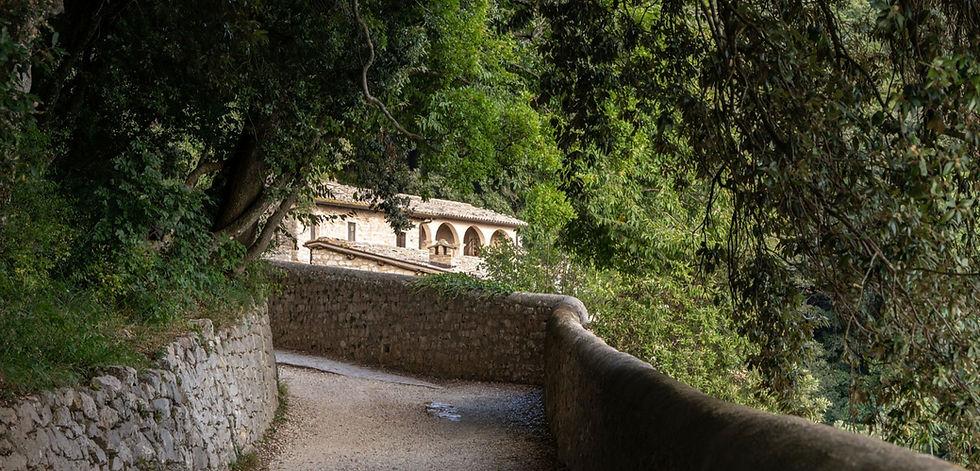
We will visit the Basilica of Saint Francis, where the paintings of Giotto offer a spiritual counterpoint to the art of Florence. Here, Dante's contemporaries learned to redirect their gaze toward the celestial realm above, and we will do the same. The Hermitage of the Carceri is where Francis withdrew into the forest to pray. It was there that he found love in its most uncluttered form. We will follow in his footsteps, learning what the natural world has to teach us about love.
Ravenna: A Glimpse of Paradise
Dante completed the Divine Comedy in Ravenna. It is the city where he eventually died, and the place where his tomb remains today.
This small Italian town, however, is not merely of biographical interest, but also forms the perfect setting for the last stage of the retreat. The celebrated Byzantine mosaics of San Vitale and the Mausoleum of Galla Placidia do not merely give visible form to paradise, but also invite us to enter it. Dante spent his final years among these images, and scholars have traced their influence throughout Paradiso. Standing before them, something of what he was reaching for becomes palpable: a love that holds everything within it, a world seen at last as it really is.
We close the retreat at Dante's tomb. Not as the end point of the journey, but as the beginning. If there is anything we can learn from Dante, it is that spiritual transformation is not easily won. What this retreat offers is therefore primarily a roadmap. Participants will learn what it takes to live a full and authentic spiritual life. And although we will reach the threshold of paradise in Ravenna, it is at home where the journey continues and the last step into paradise must be taken.
The Rhythm of the Week
The first two days of the retreat will be spent in Florence, after which we will move to Assisi, where we will stay for five days in total. The last day of the retreat will take us to Ravenna before we say goodbye and move back home.
The mornings will generally be more contemplative in nature. We will start the day with meditation and silence, followed by a group meeting for a guided reading of the Divine Comedy and a lecture that foregrounds the everyday spiritual implications of Dante’s text. The afternoons are generally more interactive in character, dedicated to the direct encounter with the places we visit and creative or spiritual workshops. In the evening, we will first contemplatively integrate our experiences of the day on an individual basis, and conclude the day as a group with reflection and conversation.
The opening of our hearts mirrors the opening of our eyes. We see art as it was intended: an aid for meditation and a portal to the divine.
Dante did not make his journey alone. He needed guides, companions, and friends. And so do we. As a retreat that is primarily about learning to love, the communal aspect of the work will be foregrounded throughout. The same goes for the role of art in our practice. The opening of our hearts will find its counterpart in the opening of our eyes, and part of the retreat will be dedicated to training our capacity to learn to see the artwork as it was originally intended. Not as an image to be consumed or aesthetically appreciated, but as a devotional image that functions at once as an aid for meditation and as a portal to the divine. In this respect, our path from Florence to Assisi and Ravenna is also a journey back in time, aimed to restore a contemplative mode of looking that is all but lost.


